AI Agent for Real Estate Versus Traditional Realtors in 2026
By 2026, the commercial real estate landscape is shifting at an unprecedented pace. Nearly 70% of initial client interactions are now managed by intelligent systems, signaling that the rise of the AI agent for real estate is more than a passing trend, it represents a fundamental transformation. These agents are redefining how deals are executed, assets are managed, and data is translated into actionable insights. This evolution challenges the traditional realtor model, prompting a complete reevaluation of processes from lead generation to portfolio optimization. This article explores AI capabilities, the evolving role of realtors, and key considerations for stakeholders navigating this new era.
The Rise of AI Agents in Real Estate
The pace of innovation in commercial real estate is staggering. By 2026, the majority of brokerages and asset managers have adopted an ai agent for real estate to streamline everything from lead capture to compliance. According to a recent industry survey, 97 percent of real estate professionals are now leveraging AI tools, signaling a fundamental shift in how deals and assets are managed. 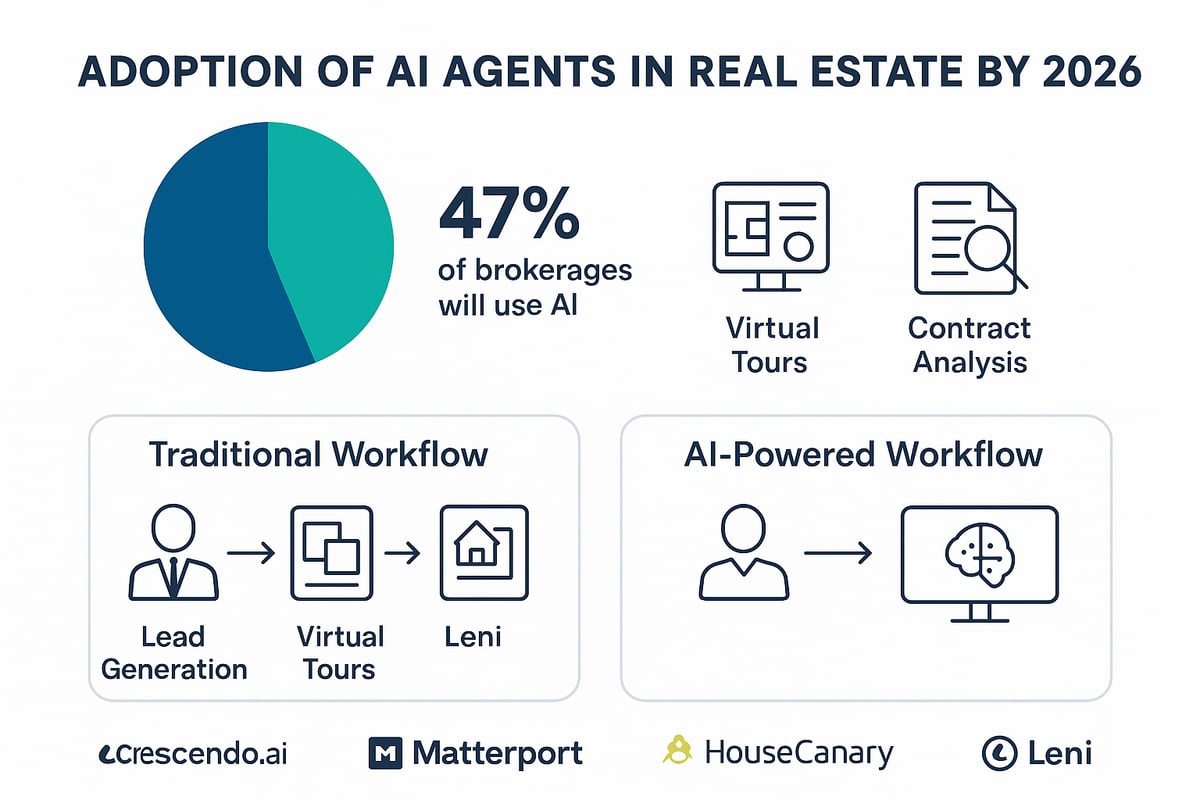
Defining AI Agents and Their Core Capabilities
What exactly is an ai agent for real estate? At its core, it is an autonomous, data-driven system engineered to tackle complex tasks across the transaction lifecycle. These agents leverage generative AI, natural language processing, and machine learning to execute:
- Instant lead qualification and 24/7 client engagement (Crescendo.ai)
- Seamless, AI-powered virtual tours for remote buyers (see Matterport and virtual tours for a deep dive)
- Contract analysis and rapid risk flagging using platforms like Luminance and Juro
- Automated valuation models (AVMs) with near real-time accuracy, as seen with HouseCanary
By 2026, agentic AI systems have evolved to learn from vast CRM and market data, adapting their responses and strategies on the fly. The result? AI agents now handle up to 70 percent of initial client inquiries and automate 80 percent of document reviews. This makes the ai agent for real estate a critical lever for scalability, eliminating operational bottlenecks and enabling continuous service.
Key Drivers Behind AI Adoption in Real Estate
The adoption of AI agents in real estate is driven by a combination of operational pressures, client expectations, and market dynamics. Firms are increasingly turning to AI to streamline processes, reduce costs, and stay competitive in a rapidly evolving landscape. Key factors fueling this shift include:
- Data Overload: Asset managers handle vast amounts of operational, financial, and market data, making real-time analytics essential.
- Cost Efficiency: AI solutions like MagicDoor can reduce property management expenses by up to 60%.
- Client Expectations: Buyers and tenants demand instant, personalized responses and engaging digital experiences.
- Regulatory Compliance: AI-powered contract review platforms simplify compliance, reduce risk, and speed up turnaround.
- Market Pressures: Events such as the high interest rates of 2025 have accelerated automation adoption.
- Global Reach: AI agents facilitate multilingual, cross-border transactions, opening opportunities for international investors and tenants.
- Operational Clarity: AI provides a streamlined path for decision-making amid complexity, enhancing overall efficiency.
The Evolving Role of Traditional Realtors in 2026
In 2026, the rise of the ai agent for real estate has transformed the industry’s operational backbone. Yet, the essence of human expertise remains vital, especially as real estate deals grow in complexity. While AI tools automate routine tasks, traditional realtors continue to play a pivotal role in high-stakes transactions and nuanced decision-making. 
Core Strengths and Value Propositions
Despite the rapid adoption of the ai agent for real estate, traditional realtors retain unique strengths that technology cannot easily replicate. Their value lies in:
- Building deep, trust-based relationships with clients
- Leveraging local market knowledge to uncover hidden opportunities
- Navigating complex negotiations with empathy and nuance
- Acting as trusted advisors during high-emotion or intricate transactions
- Managing legal, regulatory, and ethical concerns with seasoned judgment
Realtors are not standing still. Many now use AI tools for CRM automation, virtual staging, and data-driven marketing, blending efficiency with a personal touch. According to the NAR 2025 Technology Survey, 97% of agents integrate some form of AI into their workflow. This hybrid approach allows realtors to automate routine steps while focusing on what matters most: guiding clients through the most significant financial decisions of their lives. Recent data shows that 65% of buyers in 2025 still preferred some level of human guidance, especially for unique property types and challenging market conditions. The ai agent for real estate excels at speed and analytics, but the human element remains essential for trust and complex problem-solving.
Challenges Facing Traditional Agents
The growing presence of the ai agent for real estate introduces real challenges for traditional agents:
- Increased competition from tech-enabled brokerages and AI-first platforms
- Higher client expectations for rapid response and full transparency
- The need to master emerging tools, workflows, and compliance protocols
- Risk of being bypassed in standardized or lower-value transactions
To stay relevant, agents must continually adapt—learning new digital skills, embracing AI-driven insights, and focusing on high-touch, advisory services. The risk of disintermediation is real, especially as more transactions become automated and clients seek instant answers. Still, the future points toward a hybrid model, where the ai agent for real estate handles scale and data, and realtors deliver the personal connection, negotiation, and judgment that no algorithm can match. The most successful agents in 2026 are those who blend technology with human expertise, creating value far beyond what either could achieve alone.
AI Agents vs. Traditional Realtors: Side-by-Side Comparison
In 2026, the debate between the ai agent for real estate and traditional realtors is more than theoretical. The shift is tangible, especially for asset managers who need to cut through data overwhelm and drive better outcomes. Let’s break down the differences that matter most.
Efficiency, Accuracy, and Cost
AI agents deliver instant responses, automate document workflows, and provide 24/7 service—an operational advantage for busy asset managers. Tools like Scheduler.ai make appointment-setting seamless, while platforms such as Leni centralize data and automate reporting. Traditional realtors, by contrast, are limited by office hours and manual processes. Human error and scheduling delays can slow deals. Cost is a deciding factor: AI agents can reduce property management operating expenses by up to 60 percent, according to MagicDoor. For those considering the latest AI software for real estate, it’s clear that automation is changing the cost structure and scalability equation. The ai agent for real estate is fast becoming the backbone of operational efficiency.
Client Experience and Personalization
The ai agent for real estate offers consistent, data-driven recommendations and personalized property alerts, often anticipating client needs before they’re voiced. RealScout, for example, uses AI to send tailored listings based on client behavior. Traditional realtors excel in empathy, reading between the lines, and building trust—especially in high-stakes or emotional transactions. The hybrid model is emerging: realtors leverage AI for routine tasks, freeing them to focus on deep relationship-building and bespoke advice.
Market Insight, Valuation, and Reporting
When it comes to market insight, the ai agent for real estate leverages real-time analytics, predictive valuations, and automated reports. HouseCanary’s AVMs, for instance, offer valuations with approximately 2.5 percent accuracy. Leni’s dashboards summarize asset performance and benchmark portfolios in moments, not days. Traditional realtors offer a different kind of value: nuanced local knowledge, off-market opportunities, and the ability to interpret soft signals that algorithms might miss. The best results often come from combining both approaches.
Compliance, Risk Management, and Transaction Complexity
AI agents excel at reviewing contracts, flagging compliance risks, and accelerating lease processing. Platforms like Luminance and Juro automate up to 90 percent of standard lease reviews, minimizing human oversight. Traditional realtors step in for edge cases—unique properties, complex negotiations, or when regulations shift. Their judgment and adaptability remain critical in non-standard scenarios.
Limitations and Gaps
Despite its strengths, the ai agent for real estate struggles with emotional intelligence, highly nuanced negotiations, and rare exceptions. Technology is not yet a full substitute for the human touch. Conversely, traditional realtors cannot match the scale, speed, or data processing power of AI. Relying solely on manual methods can introduce bias or slow down decision-making.
AI in Multifamily Asset and Portfolio Management: Solving the Data Overwhelm
The multifamily sector faces a tidal wave of data in 2026. Asset managers now oversee vast portfolios with thousands of data points streaming in daily. The result? Many teams spend more time wrangling spreadsheets than making strategic decisions. Enter the ai agent for real estate, designed to turn data chaos into clarity and drive real value at scale.
The Data Challenge for Asset Managers
Multifamily asset managers juggle operational, financial, and market data from disparate sources. Traditional systems often isolate information, making it hard to spot trends or benchmark performance across properties. Manual reporting slows decision-making and increases the risk of errors. As portfolios grow, the data burden can paralyze teams, leaving value on the table. This is where an ai agent for real estate becomes indispensable, centralizing fragmented data and surfacing insights in real time. For a deeper dive into how data centralization and AI are transforming multifamily operations, see Data centralization and AI in multifamily.
Next-Gen AI Solutions: Case Study – Leni
Leni stands out as a next-gen ai agent for real estate, purpose-built for multifamily asset management. It automates asset performance tracking, portfolio benchmarking, and KPI-driven reporting, all from a single, intuitive dashboard. Leni’s modular analysts, like Grace for market research and James for audit, tackle specialized tasks with precision. The platform delivers instant summaries, interactive dashboards, and automated compliance checks. Unlike legacy tools that require hours of manual data aggregation, Leni produces actionable insights in seconds, freeing up teams to focus on NOI growth and operational strategy.
Comparison to Legacy Systems and Real-World Impact
Compared to legacy systems, an ai agent for real estate like Leni offers transformative value. Asset managers using Leni report faster, more accurate decision-making and stronger portfolio optimization. Here’s how Leni outperforms traditional workflows:
| Function | Legacy Approach | Leni AI Agent Approach |
|---|---|---|
| Data Aggregation | Manual, slow | Automated, real-time |
| Benchmarking | Infrequent, static | Continuous, dynamic |
| Compliance Reporting | Labor-intensive | Automated, instant |
| Insight Generation | Delayed, partial | Actionable, holistic |
Trusted by major institutional owners, Leni’s AI-driven analytics help teams move from reactive reporting to proactive asset management. The shift is clear: the ai agent for real estate is now the backbone of high-performing multifamily portfolios.
Key Considerations for Stakeholders in the AI-Driven Real Estate Landscape
Navigating the AI-driven real estate landscape in 2026 means rethinking traditional roles, workflows, and success metrics. Each stakeholder—from asset managers to renters—faces unique challenges and opportunities as the ai agent for real estate becomes the new standard. Here is what matters most for each group.
For Asset Managers and Owners
Today’s asset managers are drowning in data. To thrive, teams must evaluate their readiness to deploy an ai agent for real estate. Start by assessing data quality, integration capabilities, and willingness to adapt workflows. Tools like Leni automate performance tracking, reporting, and benchmarking, freeing up time for real decision-making. Real-time dashboards and compliance checks allow asset managers to optimize NOI and scale portfolios efficiently. For deeper success metrics, review the Essential KPIs for real estate marketing. Ultimately, the right AI solution enables a hybrid strategy—AI for routine data, humans for judgment.
For Realtors and Brokerages
Realtors must embrace the ai agent for real estate as a force multiplier, not a replacement. Upskilling is non-negotiable: virtual tours, automated CRMs, and predictive analytics are now baseline expectations. Hybrid models are thriving. Brokers who blend personal relationships with AI-powered efficiency deliver the high-touch experience clients still want. According to the Delta Media AI Survey 2026, 97 percent of agents have adopted AI tools. This shift means realtors must focus on trust, adaptability, and ongoing training to stay relevant.
For Technology Providers and Innovators
The ai agent for real estate ecosystem demands tools that are explainable, secure, and easy to integrate. Providers must prioritize user experience and ensure seamless adoption within existing workflows. Key challenges include addressing edge cases, safeguarding data, and complying with evolving regulations. Continuous innovation is required, but so is transparency—users need to understand how decisions are made. Successful providers balance technical advancement with reliability and industry trust.
For Buyers, Sellers, and Renters
Clients benefit from instant insights and personalized service powered by an ai agent for real estate. However, understanding the limits of automation is essential. Know when to lean on AI for transparency and speed, and when to seek human guidance for complex decisions. Protecting personal data and understanding privacy policies should be top of mind. The best experience comes from platforms that blend AI efficiency with human empathy.
Future Outlook: The Path Forward
The next few years will see even greater convergence of ai agent for real estate technology and human expertise. Hybrid models—where AI handles data, reporting, and compliance, and humans focus on negotiation and strategy—will set the new standard. Industry-wide, adaptability and continuous learning are crucial. Ethical frameworks, clear standards, and robust regulatory oversight will guide responsible innovation. The winners will be those who embrace change, invest in upskilling, and leverage AI to solve real business problems. AI agents are accelerating everything from lead capture to asset benchmarking—while traditional realtors continue to provide hands-on guidance for high-stakes deals. For those managing multifamily portfolios, now is the time to leverage actionable, real-time insights to enhance NOI. Platforms like Leni help track performance, automate reporting, and optimize revenue, allowing teams to focus on strategic decisions rather than data wrangling. Experience the next level of CRE analytics firsthand and unlock smarter, faster portfolio management.

Leni
Centralize performance signals, surface opportunities, and accelerate data-driven decisions across your multifamily portfolio today.
MEET LENI
Get Portfolio Insights With Leni Analytics
Dive into a live demonstration of Leni Analytics and discover how intuitive data visualization and real-time insights can transform your decision-making process.
Capabilities