Multifamily Lease Abstraction Powered by AI Technology
The commercial real estate market demands speed and precision in ways that traditional lease review processes struggle to deliver. For multifamily operators managing portfolios of hundreds or thousands of units, the sheer volume of lease documentation creates a bottleneck in acquisitions, dispositions, and ongoing compliance management.
AI lease review CRE technology has emerged as the operational catalyst that transforms weeks of manual abstraction into hours of verified, actionable data. This shift enables asset managers and legal teams to identify risks faster, validate rent rolls with greater confidence, and accelerate transaction timelines without sacrificing analytical depth.
The Traditional Lease Review Bottleneck in Multifamily
Lease review has historically represented one of the most labor-intensive phases of multifamily due diligence. Each unit lease contains critical data points: base rent, lease term, renewal options, pet policies, parking addenda, utility responsibilities, and security deposit amounts. Multiply these details across a 300-unit asset and the abstraction workload becomes substantial.
Manual review processes introduce three primary challenges:
- Time constraints that compress diligence periods and delay closing dates
- Human error in data transcription that undermines rent roll accuracy
- Inconsistent capture of unusual clauses that may impact NOI projections
Asset managers traditionally relied on junior analysts or third-party services to extract this information into spreadsheets. A single lease might take 20 to 45 minutes to abstract properly, depending on complexity and document quality. For a midsized acquisition, this translates to 100 to 200 hours of pure abstraction labor before analysis even begins.
The cost extends beyond time. Missed clauses, such as atypical renewal rights or below-market rent concessions embedded in older leases, can materially affect underwriting assumptions. When these discrepancies surface post-closing, they erode projected yields and complicate asset stabilization plans.
How AI Lease Review CRE Technology Processes Documents
Modern AI lease review CRE platforms leverage natural language processing and optical character recognition to extract structured data from unstructured lease documents. The technology reads PDFs, scanned images, and native Word files with equal facility, identifying clause types through pattern recognition trained on thousands of commercial and residential leases.
The process unfolds in distinct phases. First, document ingestion converts files into machine-readable text, correcting for image quality issues and formatting inconsistencies. Next, NLP models classify sections of the lease: identify the parties, locate the premises description, isolate financial terms, flag special provisions. AI-powered natural language processing reduces lease abstraction time from hours to minutes while maintaining accuracy levels that exceed manual review.
Key Data Extraction Categories
AI systems structure extraction around the data fields most critical to real estate decision-making:
| Data Category | Extracted Fields | Downstream Impact |
|---|---|---|
| Financial Terms | Base rent, escalations, CAM charges, percentage rent | Revenue projections, NOI modeling |
| Temporal Data | Commencement date, expiration, renewal options, notice periods | Lease expiration schedules, rollover risk |
| Operational Clauses | Maintenance obligations, insurance requirements, alterations rights | OPEX forecasting, compliance tracking |
| Termination Rights | Early termination provisions, co-tenancy clauses, force majeure | Occupancy risk assessment, scenario planning |
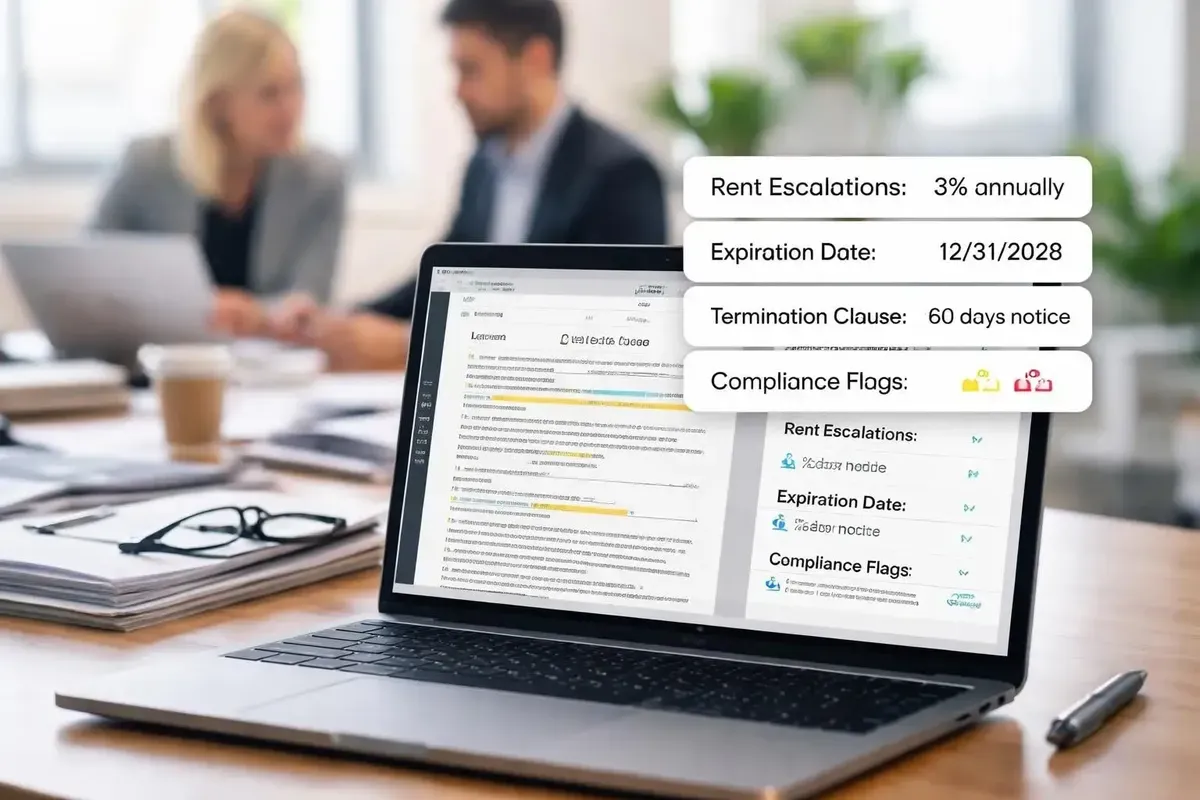
The sophistication lies in contextual understanding. An AI lease review CRE system doesn’t just locate a dollar amount; it determines whether that figure represents base rent, a security deposit, or a one-time fee. It recognizes that “annual increase of 3%” in one section relates to the base rent identified earlier, linking these concepts into a structured escalation schedule.
For multifamily portfolios, this precision matters acutely. A 200-unit property might have 180 occupied units with active leases, each containing variations in pet fees, parking charges, and utility billing arrangements. Automated extraction ensures these revenue streams populate financial models accurately, supporting more confident underwriting.
Risk Identification and Compliance Automation
Beyond raw data extraction, sophisticated AI lease review CRE platforms perform interpretive analysis that flags provisions requiring heightened scrutiny. This analytical layer transforms abstraction from a transcription exercise into a risk management function.
Automated compliance checking represents a significant value driver for institutional owners managing regulatory obligations across multiple jurisdictions. AI automates lease compliance checks by extracting key dates, clauses, and financial obligations, reducing manual review time while minimizing errors that could trigger penalties or legal disputes.
Common Risk Flags in Multifamily Leases
AI systems identify anomalies that warrant additional legal or operational review:
- Below-market rent: Leases priced more than 15% below comparable units, indicating potential concessions or legacy tenant arrangements
- Unusual termination rights: Provisions allowing tenants to break leases with minimal notice, creating unexpected vacancy risk
- Atypical renewal terms: Automatic renewals or renewal rates disconnected from market escalation patterns
- Conflicting clauses: Contradictory language regarding responsibilities for repairs, utilities, or common area access
Tools like Leni are built specifically for real estate workflows, meaning they understand the language of leases: rent structures, escalation clauses, expiry dates, termination rights, and exclusivity provisions. Beyond extraction, systems flag unusual or risky clauses and draft negotiation points directly, so legal and acquisitions teams spend less time identifying issues and more time resolving them.
This capability proves particularly valuable during portfolio acquisitions where lease quality varies significantly. An AI lease review CRE platform might surface that 12% of units have month-to-month holdover tenants, a finding that immediately informs stabilization budgets and timeline projections.
Integration with Transaction Workflows
The operational value of AI lease review CRE technology manifests most clearly when integrated into existing transaction and asset management systems. Standalone abstraction produces data; integrated workflows produce decisions.
Leading operators now incorporate automated lease review into several critical processes:
- Initial underwriting: AI extraction populates rent rolls and revenue assumptions within hours of receiving seller documents, accelerating preliminary valuation and bid preparation
- Due diligence validation: Automated comparison between extracted lease data and seller-provided rent rolls identifies discrepancies requiring immediate investigation
- Post-acquisition integration: Structured lease data flows directly into property management systems, eliminating manual re-entry and enabling day-one operational continuity
- Portfolio monitoring: Ongoing extraction of new leases and amendments maintains current lease abstracts without dedicated administrative resources
This integration reduces the basis points of friction in transaction execution. When lease review compresses from three weeks to three days, acquisitions teams can pursue more opportunities simultaneously without expanding headcount. The throughput advantage becomes competitive differentiation in hot markets where speed to letter of intent determines whether a deal proceeds.
For firms leveraging private equity management software across their platforms, seamless data flow from AI lease review into portfolio analytics creates a unified view of performance. Asset managers can track lease-level metrics (renewal rates, rent growth, concession usage) alongside property-level NOI and portfolio-level returns without manual data reconciliation.
Accuracy Benchmarks and Quality Control
Skepticism regarding AI accuracy in legal document review remains persistent, and appropriately so. Lease language carries contractual weight; extraction errors can lead to material misunderstandings about cash flow timing, tenant obligations, or termination rights. The industry’s adoption of AI lease review CRE technology has therefore proceeded with rigorous validation protocols.
Performance Metrics in Practice
Recent implementations demonstrate extraction accuracy rates exceeding 95% for standard lease fields when measured against expert human review. Complex or non-standard provisions show slightly lower initial accuracy (88-92%), but these clauses typically receive automatic flagging for human verification.
| Lease Complexity | AI Accuracy Rate | Average Processing Time | Human Review Time Saved |
|---|---|---|---|
| Standard Residential | 97-99% | 3-5 minutes | 85-90% |
| Residential with Addenda | 94-96% | 6-9 minutes | 75-82% |
| Mixed-Use/Commercial Hybrid | 89-93% | 12-18 minutes | 65-72% |
| Legacy/Handwritten Amendments | 82-88% | 15-25 minutes | 45-55% |
Quality control mechanisms within AI lease review CRE platforms typically include confidence scoring for each extracted field. When the system processes a lease and assigns a confidence score below a defined threshold (commonly 85%), that field receives automatic routing to a human reviewer. This hybrid approach maintains accuracy while capturing the majority of time savings.
For multifamily operators, the practical implication is that AI handles the high-volume, standardized lease forms that constitute 70-80% of a typical portfolio, while legal teams focus attention on the custom agreements and complex amendments that genuinely require nuanced interpretation. The labor reallocation optimizes talent deployment.
Economic Impact on Deal Velocity
The financial case for AI lease review CRE technology rests on quantifiable improvements in transaction efficiency and risk mitigation. Multifamily acquisitions operate within compressed timelines, where diligence periods of 30 to 45 days leave little room for delays. Lease review bottlenecks can force rushed analysis or extended contingency periods that weaken negotiating positions.
Consider a mid-market multifamily operator pursuing 8 to 12 acquisitions annually, with an average property size of 175 units. Traditional lease abstraction for each deal requires approximately 140 hours of analyst time (175 units × 48 minutes per lease). At a fully loaded cost of $75 per hour for junior analytical talent, the per-deal abstraction expense reaches $10,500.
AI lease review CRE platforms reduce this to approximately 20 hours of system processing time plus 15 hours of human review for flagged items, totaling $1,125 in direct costs per acquisition. The $9,375 savings per transaction compounds across an annual acquisition volume to $75,000 to $112,500 in reduced diligence expenses.
The velocity benefit carries additional value. Accelerated lease review allows:
- Earlier identification of deal-breaking issues, reducing wasted diligence costs on transactions that won’t close
- Faster turnaround on revised offers when initial underwriting uncovers valuation adjustments
- Parallel processing of multiple opportunities, increasing effective deal team capacity by 30-40%
For institutional investors, AI’s growing impact on commercial real estate extends beyond operational efficiency to strategic positioning, as firms that can evaluate opportunities faster capture higher-quality assets before competitors complete their analysis.
Implementation Considerations for Multifamily Operators
Deploying AI lease review CRE technology requires thoughtful integration planning to maximize adoption and value realization. The technical capabilities of these platforms have matured significantly, but operational success depends on change management and workflow redesign.
Critical Implementation Steps
Organizations should approach deployment systematically:
- Define extraction standards: Establish which lease fields matter most for your underwriting models and compliance requirements; AI systems perform best when trained on your specific data taxonomy
- Establish validation protocols: Determine confidence thresholds for automatic acceptance versus human review; calibrate these settings during initial pilot phases
- Integrate with existing systems: Plan data flow from AI extraction into property management software, financial modeling tools, and reporting platforms
- Train acquisition and asset teams: Ensure staff understand how to interpret AI-generated abstracts, confidence scores, and risk flags; the technology augments rather than replaces judgment
- Monitor accuracy metrics: Track extraction precision across lease types and document quality levels; use performance data to refine system training and validation rules
The learning curve for most platforms spans 30 to 60 days, during which teams process both AI-abstracted and manually reviewed leases in parallel. This dual-track approach builds confidence in system outputs while identifying edge cases requiring additional training.
For firms managing diverse portfolios across multiple markets, real estate data platform integration becomes particularly important. AI lease review creates structured data that gains exponential value when combined with market comps, demographic trends, and portfolio benchmarking analytics.
Beyond Acquisition: Ongoing Portfolio Management
While transaction diligence represents the most visible application of AI lease review CRE technology, ongoing portfolio management offers equally compelling use cases. Multifamily operators managing stable assets face continuous lease turnover, amendment processing, and compliance monitoring.
Asset managers at stabilized properties typically handle 30-50 new leases and renewals monthly at a 200-unit community experiencing typical 50% annual turnover. Each new lease and amendment should flow into the property management system and update financial forecasts. Manual abstraction of these documents creates administrative burden that diverts attention from revenue management and tenant relations.
Automated lease processing transforms this maintenance task into a seamless background function. New leases upload to the AI platform, extraction occurs overnight, and validated data populates operational systems without human intervention for standard forms. The asset manager receives a daily summary of new leases processed, flagged anomalies requiring review, and updated rent roll metrics.
This continuous abstraction supports several strategic capabilities:
- Real-time rent roll accuracy for portfolio reporting and investor communications
- Proactive lease expiration management with automated alerts 90, 60, and 30 days before renewal windows
- Concession tracking that quantifies the revenue impact of waived fees, reduced deposits, or free rent periods
- Compliance documentation for regulatory audits, particularly regarding fair housing practices and lease term standardization
The cumulative effect elevates portfolio management from reactive administration to proactive optimization. When lease data flows continuously into analytics platforms, asset managers identify patterns: which unit types command premium rents, which lease incentives drive highest renewal rates, how notice period requirements affect turnover timing.
Vendor Selection and Platform Differentiation
The AI lease review CRE market has expanded rapidly over the past 24 months, with platforms ranging from general-purpose document intelligence tools to specialized real estate applications. Multifamily operators evaluating solutions should assess capabilities across several dimensions beyond basic extraction accuracy.
Real estate specificity matters significantly. Generic NLP platforms trained on broad document types often struggle with lease-specific terminology and clause structures. Purpose-built real estate systems recognize concepts like tenant improvement allowances, percentage rent calculations, and co-tenancy provisions because they’ve trained exclusively on commercial and residential lease documents.
Customization flexibility enables platforms to adapt to your organization’s unique lease forms and data requirements. Some vendors offer rigid extraction templates that may not align with your underwriting model’s specific data fields. Others provide configurable extraction rules and custom field mapping.
Integration architecture determines how easily AI-extracted data flows into your existing technology stack. A European law firm utilized AI tools to review over 60 commercial leases, demonstrating how proper integration enhances efficiency across legal and operational teams.
Security and data privacy protections warrant particular attention given the sensitive financial information contained in leases. Cloud-based platforms should provide SOC 2 Type II compliance, encryption at rest and in transit, and granular access controls.
Measuring Return on Investment
Quantifying the financial impact of AI lease review CRE technology requires tracking both hard cost savings and operational efficiency gains. The calculation extends beyond simple cost-per-lease comparisons to encompass deal velocity improvements and risk mitigation value.
ROI Components
| Benefit Category | Measurement Approach | Typical Annual Value (200-unit portfolio operator) |
|---|---|---|
| Reduced Labor Costs | Hours saved × loaded labor rate | $75,000-$110,000 |
| Faster Transaction Close | Days accelerated × cost of capital on deployed equity | $25,000-$45,000 |
| Improved Underwriting Accuracy | Avoided post-close adjustments and surprises | $50,000-$150,000 |
| Enhanced Compliance | Avoided penalties and legal disputes | $15,000-$40,000 |
The compliance benefit deserves particular emphasis in the current regulatory environment. Municipalities increasingly scrutinize lease terms for fair housing compliance, security deposit handling, and fee disclosure requirements. Automated extraction that flags non-compliant language enables proactive remediation before regulatory audits occur.
Portfolio operators with higher transaction volumes realize proportionally greater returns. A platform investor acquiring 20+ multifamily assets annually might see combined savings and efficiency gains exceeding $500,000 when accounting for expanded deal team capacity and reduced transaction risk.
Future Trajectory of Lease Intelligence
Lease intelligence is steadily moving beyond basic data extraction into a more strategic, insight-driven function. As AI capabilities mature, lease analysis is becoming deeply connected with broader decision-making frameworks.
1. Predictive Analytics for Smarter Leasing Decisions
Advanced systems now forecast tenant behavior, including renewal probability and potential churn, allowing teams to act before risks materialize.
2. Data-Backed Lease Optimization
By analyzing large volumes of lease data, AI identifies which terms, such as flexibility clauses or amenities, contribute to higher tenant satisfaction and retention.
3. Revenue and Rent Positioning Insights
Intelligent models assess how specific lease features influence rent premiums, helping asset managers refine pricing strategies with greater precision.
4. Scenario Testing for Lease Structures
Teams can simulate changes in lease terms and instantly evaluate their impact on renewal rates, occupancy stability, and long-term revenue performance.
5. Shift from Operational to Strategic Function
Lease review is no longer limited to diligence; it now serves as a core input for portfolio-level strategy and performance optimization.
6. Integration with real estate analytics platforms
Seamless connectivity with real estate analytics platforms allows lease-level insights to feed into market trends, competitive analysis, and portfolio allocation decisions.
7. Transformation into a Dynamic Data Asset
Lease documents are evolving from static agreements into continuously analyzed data sources that inform unit pricing, investment strategy, and capital deployment.
AI lease review CRE technology has fundamentally shifted the economics of multifamily diligence and portfolio management, compressing timelines while improving analytical depth. The tools that deliver greatest value combine high extraction accuracy with real estate-specific intelligence and seamless integration into transaction workflows.

Leni
Centralize performance signals, surface opportunities, and accelerate data-driven decisions across your multifamily portfolio today.
MEET LENI
Get Portfolio Insights With Leni Analytics
Dive into a live demonstration of Leni Analytics and discover how intuitive data visualization and real-time insights can transform your decision-making process.

Capabilities